
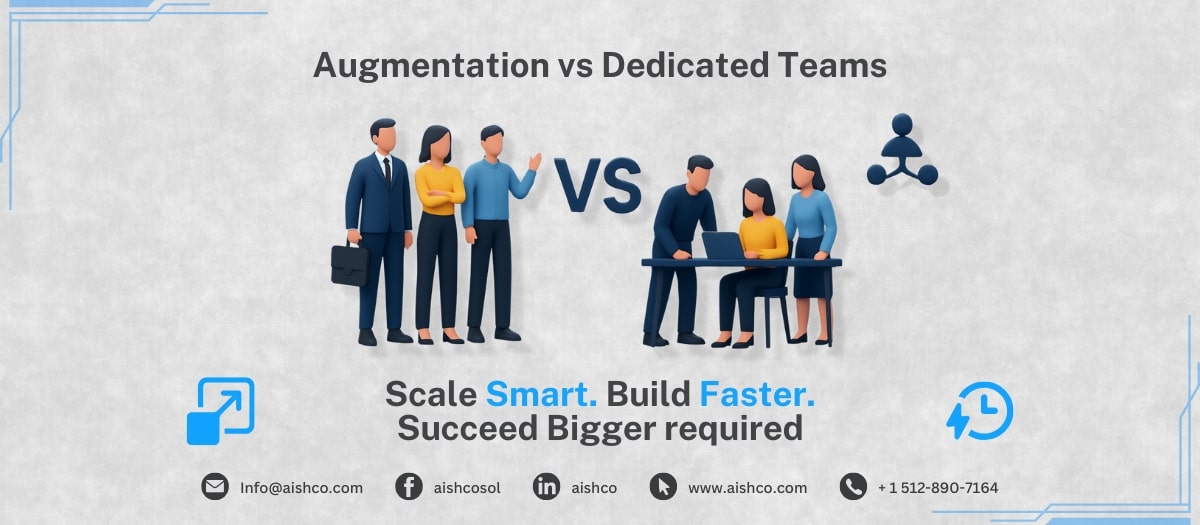

Starting a tech project can be exciting — but one of the first big questions is: how do we build the team? Two popular approaches are Staff Augmentation and Dedicated Teams. Both work well, but in different situations.
Staff Augmentation
Think of staff augmentation as “borrowing extra hands” for your existing team. You bring in specialists to help with short-term tasks or cover skills your team might be missing — without hiring full-time employees. They work side by side with your team, follow your processes, and help get things done faster.
This works best when:
- You have a short-term project
- Workload suddenly increases
- You need someone with a specific skill
- You already have a team in place
Dedicated Team
A dedicated team is like having your own outsourced team that works only on your project. It’s a full setup — developers, designers, testers, DevOps, and a project manager — all focused on your product from start to finish.
This works best when:
- You’re building a long-term or complex project
- You’re creating a new product from scratch
- You don’t have an internal tech team
- You need someone to handle the entire development cycle
High-Level Comparison
| Feature | Staff Augmentation | Dedicated Team |
| Project Duration | Short-term needs | Long-term projects |
| Hiring Speed | Fast | Medium |
| Control | Full internal control | Shared with PM |
| Cost | Cost-effective short-term | Cost-effective long-term |
| Team Size | Individual roles | Full team |
| Best For | Quick scaling | Full product development |
Detailed Comparison
1. Project Duration
Staff augmentation is ideal for temporary needs and short-term tasks. Dedicated teams deliver better stability for long-term projects.
2. Level of Control
Staff augmentation gives you direct control and full management responsibility.
Dedicated teams share the workload through an external project manager.
3. Skill Requirements
Augmentation fits when you need a single specialist.
Dedicated teams work best when projects require multiple skills together.
4. Cost & Budget
Short-term = staff augmentation is cheaper.
Long-term = dedicated teams offer better value.
5. Onboarding Time
Staff augmentation onboarding is quick (2–5 days).
Dedicated teams take slightly longer (1–2 weeks) due to structure setup.
Detailed Feature Breakdown
| Aspect | Staff Augmentation Advantage | Dedicated Team Advantage |
| Flexibility | Easily scale up/down | Stable long-term availability |
| Management Load | You manage everything | PM handles daily operations |
| Integration Speed | Faster setup | More structured process |
| Skill Diversity | Limited to hired roles | Full team skillset |
| Communication | Inside your workflow | External structured system |
| Best for | Filling skill gaps | End-to-end development |
Real-Life Example
If your tech project is already moving well and your internal team is strong — but suddenly you need an extra pair of expert hands — staff augmentation becomes the perfect shortcut. Instead of stopping everything to hire, train, and onboard a full-time employee, you simply plug in the skilled talent you need and keep going without delays.
Maybe you want a React developer to upgrade your UI, fix performance issues, or add a new feature. Or maybe you need a QA specialist before launch. In all these cases, augmentation gives you speed, control, and flexibility.
On the other hand, when you’re stepping into a big product vision — like a SaaS platform, startup idea, or enterprise-level system — there’s a lot to handle:
- Planning features
- Designing UI/UX
- Writing high-quality code
- Testing every release
- Updating product continuously
- Maintaining security and performance
That’s where a dedicated team shines. They become your consistent long-term powerhouse — thinking, planning, building, and improving right beside you.
It’s like having a full in-house department… just without the hiring stress and overhead.
How to Decide What’s Right for You?
Think of it like choosing between renting a skilled professional for a task vs. hiring a whole supportive crew for a long journey:
| Your Situation | Best Fit |
| You want quick help on a running project | Staff Augmentation |
| You need specific expertise your team lacks | Staff Augmentation |
| You’re launching a new product from scratch | Dedicated Team |
| You want continuous evolution and updates | Dedicated Team |
| You want full focus on strategy, not micromanagement | Dedicated Team |
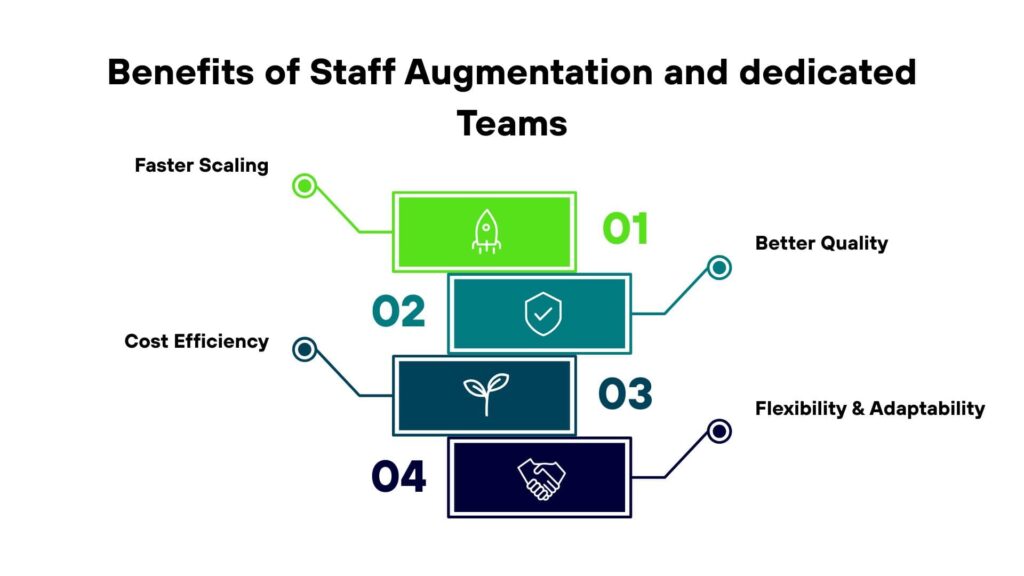
- Both models reduce development risk
- Both help you scale faster
- Both give access to experienced talent
Just the scale and duration are different.
FAQs — Quick Answers For Decision Makers
Cost-wise, which model is better?
Short projects → Staff augmentation saves money.
Long-running products → Dedicated team becomes more economical.
Can I mix both models?
Yes! You might have a dedicated team and still add extra specialists temporarily. Many companies do this during big releases.
Will communication be a problem with a dedicated team?
No — a Project Manager ensures clear communication, progress tracking, and regular reports so you’re always informed.
Can I scale up or scale down later?
Both models are flexible — you can add more developers as your project grows, or reduce team size during slower phases.
Which is better for startups?
Startups with evolving ideas benefit more from a dedicated team — because the product needs continuous shaping, not just isolated tasks.
How long does onboarding take for each model?
Staff augmentation onboarding usually takes 2–5 days.
Dedicated team onboarding may take 1–2 weeks because it includes setup of processes, tools, and communication channels.
Which model offers better control?
Staff augmentation gives you full control over daily tasks.
Dedicated teams offer shared control — you guide strategy while the project manager handles operations.
What types of projects benefit most from a dedicated team?
Complex, long-term projects like SaaS platforms, custom software, mobile apps, ERPs, and marketplaces benefit the most from a dedicated team structure.
Can I scale the team size in both models?
Yes, but staff augmentation scales faster. Dedicated teams also scale, but in a more structured way to maintain balance and quality.
Is communication smooth with external teams?
Yes. Both models offer smooth communication.
Staff augmentation integrates into your internal systems, while dedicated teams use well-defined communication frameworks.
Do dedicated teams work only for one client?
Yes, a dedicated team works exclusively on your project, ensuring focus, consistency, and quality.
What if I only need a designer or QA specialist?
Then staff augmentation is the perfect option. You can hire only the role you need without investing in a complete team.
Final Thoughts
Both team models support your success — the right one depends on:
How long your project will run
How much growth you expect
How much internal support you already have
What expertise you’re currently missing
- If speed and skill-gap filling is your priority → Staff Augmentation
- If long-term partnership and growth matter → Dedicated Team
By choosing wisely, you ensure your product gets the right support at the right time — without overspending or slowing down.