How to Use a Variable Outside of a Function PHP

In PHP, managing variable scope is crucial when trying to use variables outside their defined scope. Configuration issues are just as common, see how to enable PHP optional modules for a complete walkthrough. If you're wondering how to use a variable outside of a function PHP, you need to understand the difference between local and global scopes. By default, variables declared inside a function are local and cannot be accessed outside of it. However, you can use the global keyword or pass variables as references to use them outside the function. Local development setup matters here too, see managing PHP versions with Laravel Herd. This understanding of how to use a variable outside of a function PHP ensures that you can manage variables across different scopes effectively and avoid common pitfalls in your code.
One of the most common challenges developers face is how to use a variable outside of a function PHP. Variables declared inside functions are not accessible from outside the function unless explicitly stated. This article will explore the different types of variable scopes in PHP and demonstrate techniques for effectively managing variables. Additionally, we’ll discuss best practices and common pitfalls to ensure efficient PHP development.
What is Variable Scope in PHP?
Before we dive into how to use a variable outside of a function PHP, it’s essential to understand the variable scopes PHP offers:
Global Scope
Variables declared outside any function or class are in the global scope and can be accessed anywhere in the script.
Static Scope
Static variables retain their value between function calls.
Superglobal Scope
PHP provides predefined global variables like $_GET, $_POST, $_SESSION, etc., which are accessible anywhere.
Understanding these scopes provides a foundation for learning how to use a variable outside of a function PHP effectively.
Methods to Use a PHP Variable Outside a Function
Using the global Keyword
A straightforward way to address how to use a variable outside of a function PHP is by leveraging the global keyword. This allows a function to access and modify a globally scoped variable.
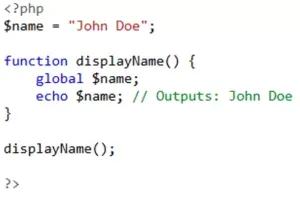
Here, the global keyword grants the function access to the $name variable declared outside it.
Using the $GLOBALS Array
Another common approach for solving how to use a variable outside of a function PHP is utilizing the $GLOBALS array. This superglobal array stores all global variables as key-value pairs.
Example
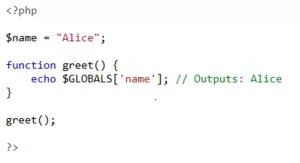
This method is especially helpful when you need to access multiple global variables within a function.
Passing Variables as Parameters
For those looking to learn how to use a variable outside of a function PHP while keeping their code modular, passing variables as parameters is a highly recommended method. It defines the inputs explicitly, reducing the reliance on global variables.
Example
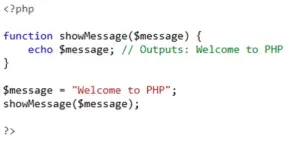
This method avoids potential issues with variable scope and ensures clarity.
Returning Values from Functions
Another technique for addressing how to use a variable outside of a function PHP is by returning values from a function and assigning them to variables outside the function.
Example
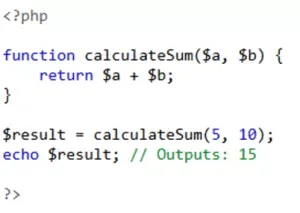
Using return values promotes cleaner and more maintainable code.
Handling Global Variables Efficiently
As you explore how to use a variable outside of a function PHP, managing global variables efficiently becomes crucial:
Minimize the Use of Globals
Overusing globals can lead to tightly coupled code and debugging challenges.
Use Constants for Unchanging Data
Constants are globally accessible and immutable, making them ideal for settings like API keys or error codes.
Embrace Dependency Injection
Dependency injection is a design pattern that helps manage variables across functions without relying on global variables. Example 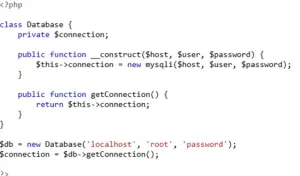
This approach keeps variables isolated, simplifying maintenance.
Advanced Concepts: Static Variables and Closures
Static variables and closures offer additional ways to manage how to use a variable outside of a function PHP effectively.
Static Variables
Static variables retain their value across multiple function calls without becoming globally accessible.
Example
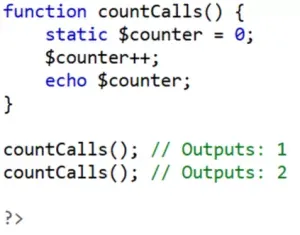
Closures
Closures enable functions to access variables outside their scope without making them global.
Example
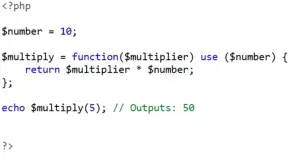
These advanced techniques further enhance your understanding of how to use a variable outside of a function PHP.
Best Practices for Managing Variables
Minimize Global Variables
Use local variables wherever possible to avoid unintended side effects.
Encapsulate Configuration
Store settings in a configuration class or file for better organization.
Leverage Dependency Injection
Pass dependencies explicitly to keep your functions modular.
Use Descriptive Names
Avoid generic names like $var or $data to improve code readability.
Avoid Overusing Superglobals
Validate and sanitize superglobal inputs to ensure security.
Common Pitfalls and How to Avoid Them
Overuse of Global Variables
Problem: Code becomes tightly coupled, leading to maintenance issues.
Solution: Use encapsulation and pass variables as arguments instead.
Scope Confusion
Problem: Variables unintentionally overwrite others in different scopes.
Solution: Use namespaces and descriptive names.
Unintended Modifications
Problem: Modifying a global variable in one function affects its behavior elsewhere.
Solution: Avoid direct modification; use return values or cloned objects.
Useful PHP Resources for Managing Variable Scope
| Resource Name | Description | External Link |
|---|---|---|
| PHP Manual: Variable Scope | Official PHP documentation explaining variable scopes. | PHP Manual - Variable Scope |
| W3Schools PHP Tutorial | Beginner-friendly tutorials on PHP variable management and functions. | W3Schools PHP Tutorial |
| MDN Web Docs: PHP Basics | A trusted source for web development fundamentals, including PHP. | MDN Web Docs - PHP |
| TutorialsPoint PHP Guide | Step-by-step guide on PHP concepts, including variables and functions. | TutorialsPoint - PHP Guide |
Conclusion
Learning how to use a variable outside of a function PHP is an essential skill for any PHP developer. By understanding variable scopes, leveraging the global keyword, utilizing the $GLOBALS array, and employing techniques like passing parameters and returning values, you can write clean, efficient, and maintainable code.
By adopting best practices like minimizing global variables, encapsulating configurations, and using dependency injection, you ensure your PHP projects remain robust and scalable. Advanced concepts like static variables and closures add further depth to your toolkit, enabling you to handle complex scenarios with ease.
Mastering how to use a variable outside of a function PHP is not just about technical knowledge but also about writing code that is logical, organized, and prepared for growth.


